
I had to remove the flywheel to replace the crankcase breather as the old one would “squawk” with the last few revolutions after key off. I didn’t figure that out until I was filling it with oil and my brain was going “Steady....
steady....
steady.....
DUMP ALL THE OIL INTO THE FUNNEL AT ONCE!!!” and the excess pressure vented through the breather, creating a much quieter but identical “squawk.” Aha!
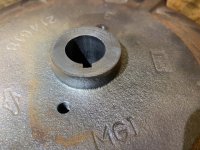
I noticed the flywheel has a hairline crack in it on the flange surface for the shaft nut. I can’t say for sure how long it’s been there - I don’t remember seeing it the first time I took it off last year, and I’ve only had this engine running for a few minutes since my tear down. I only used a light coating of oil on the shaft (NOT the threads) when installing the flywheel, and I torqued the shaft nut to 150 ft-lbs per the B&S intek service manual I bought. The shaft, key, nut and washer are all in good condition.
I know cast iron tends to continue cracking once it starts, and when fully seated, there’s outward pressure on the flywheel not only from spinning but also from the interference fit on the shaft. I recognize there’s significant chance of injury and/or pants pooping to the operator and bystanders if the flywheel splits completely through.
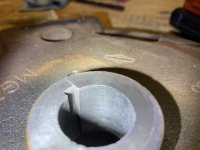
Keeping that in mind, I’m not sure what to make of this one. It only appears to be in the raised flange area of the flywheel. The crack is visible on the inner and outer surfaces but no light is visible through it when holding a flashlight behind it, and it doesn’t look like it’s extending into the flywheel yet.
I didn’t know if this is a common thing among small engines and it’s nothing to worry about or if....
I can take more pics if requested.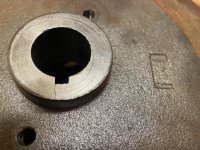
steady....
steady.....
DUMP ALL THE OIL INTO THE FUNNEL AT ONCE!!!” and the excess pressure vented through the breather, creating a much quieter but identical “squawk.” Aha!
I noticed the flywheel has a hairline crack in it on the flange surface for the shaft nut. I can’t say for sure how long it’s been there - I don’t remember seeing it the first time I took it off last year, and I’ve only had this engine running for a few minutes since my tear down. I only used a light coating of oil on the shaft (NOT the threads) when installing the flywheel, and I torqued the shaft nut to 150 ft-lbs per the B&S intek service manual I bought. The shaft, key, nut and washer are all in good condition.
I know cast iron tends to continue cracking once it starts, and when fully seated, there’s outward pressure on the flywheel not only from spinning but also from the interference fit on the shaft. I recognize there’s significant chance of injury and/or pants pooping to the operator and bystanders if the flywheel splits completely through.
Keeping that in mind, I’m not sure what to make of this one. It only appears to be in the raised flange area of the flywheel. The crack is visible on the inner and outer surfaces but no light is visible through it when holding a flashlight behind it, and it doesn’t look like it’s extending into the flywheel yet.
I didn’t know if this is a common thing among small engines and it’s nothing to worry about or if....
I can take more pics if requested.


