Oil measurement question

tom_l

Forum Newbie
I have a 1994 Briggs 18hp opposed twin engine (model 422707, type 1263-01, code 9403045B) on a Huskee garden tractor and am unclear on the correct oil measurement method. The manual states that 48 oz is the oil capacity for an engine without a filter, and 56 oz for one with a filter. It also states to place the dipstick in the oil feed tube to measure the oil level, but does not state to thread it snug and remove to read the level. The tractor engine has no filter, so 48 oz should fill the sump to the Full line on the dipstick. However when I follow the manual instruction to measure the oil level after an oil change, 48 oz raises the oil level to the Add mark at the bottom of the crosshatch area on the dipstick. When the dipstick is fully threaded down, 48 oz measures at the Full mark on the top of the crosshatch area. I do not want to run it on low oil or in the alternative use too much oil. Which measuring method is correct for this engine? Is 48 oz the correct amount of oil when it lacks an oil filter?
Thank you for any assistance.
 
you are going to get many conflicting answers on this. Many dipsticks that screw in have a notch that allows a bump on the dipstick to drop into before it begins being screwed in. I line that up and let the dipstick bump drop into the notch but do not turn it. I keep a clean rag or paper towel ready to clean it and do it again, making sure both times agree. Sometimes it helps to turn the dipstick over to see an accurate level.
 
It’s kind of odd.
My experience is Briggs you screw in to check the oil.
Honda is you do not typically screw the dipstick in. This allows a bit more oil to read full.
Kohler is you do not typically screw the dipstick in. Again, it allows a bit more oil to read full.

I think 48 oz is a good starting point. Would I be good to add the 48 oz, check it without screwing it in and filling til mid way across the cross hatches-ABSOLUTELY

Hope my answer helps?
 
If in doubt;

My understanding is, in a vertical shaft engine, the oil level should not be above the split/join in the cancase.
Place the dipstick on the outside of the holder, cap resting on the top, observe where the MAX level line relates to the crankcase split.

Is the MAX line at or above the split?
  • If at the split, then the cap should not be screwed down to check oil level
  • If above the split, the cap should be screwed don to check oil level
:devilish:
 
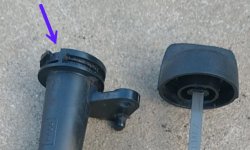
everyone missed the point so I will make it again. Pushing "the dipstick back in" is capable of yielding two different results. If the protrusion on many oil caps, is placed into the notch on the filler, the dipstick will go further into the filler tube than if it is pushed down out of that position. Double check the dipstick to see if it has such a notch and protrusion. The filler caps I have on all my oil dipsticks have a setup like that.

dip.jpg
 
I agree that the cap has to engage with the cutout you show. This type of dipstick doesn't usually screw down into the shaft, the tabs on the cap grab the lip when you turn it. It may pull down just a little bit, but not like the ones that are threaded and actually screw in.
 
Ah, the illusive oil stick that has plagued owners for years especially if they are perfectionists....

Just think, engineers do this stuff to create confusion. If the level reaches the middle of the stick after checking a couple of times in a row, leave well enough alone.

If it smokes or has drips and leaks, check the oil more often. Air-cooled engines do use a little oil. It is best to check the oil when cold to get a true reading and heat has not expanded the oil volume.
 
Back
Top