Oil brand and type

Sundaypilot

Forum Newbie
Hello I have a 1976 anniversary edition 4108, I rebuilt the engine and installed a cast iron sleeve. And an early 80’s 6211 that I engine swapped an opposed 19.5 hp Briggs into. Both run great and use very little oil. I was just wondering what you guys use for oil. As for me I use Phillips Victory 20-50 aviation oil. It’s my reasoning that they both (piston planes and mowers) are air cooled and run near redline most of the time. Anyone have any other options?
 
Sounds like you are using better oil than what the OEM recommended back when new. Most all OE engines have been prescribed to use SAE 30 or 10W-30 for years.

I tend to prefer Royal Purple because I run it is all of my old Harley's. It's great oil. Other that I use Castrol GTX.

Down here in South TX, 20W 50 works perfect in any air-cooled engine.
 
There are two things to consider when it comes to oil, first is if it doesn't have an oil filter or pump, then you need to run a non-detergent oil.
Most automotive oils are multi-weight. (5W-20, 10W-30, etc)
most non-detergent oils are straight weight oils. (20W, 30W and so on)

In an engine with no means to filter out wear particles, carbon, and dirt, you want that junk to settle out of the oil and not be carried through the engine with the oil. Detergent oils are designed to carry that dirt and debris to the filter where its trapped and removed.

Viscosity is important, too thin when its hot out and it can't protect the engine, too thick when its cold and its like molasses when its cold and the motor won't turn over.

10W30 is fine in most small engines but since most older motors don't have a filter or oil pump, (they rely on splash lubrication), the detergent factor is where the problem lies. Especially on a new motor that's still breaking in.

One problem I find these days is that there are no goo quality single grade non detergent oils, most are low grade mineral oil at best.
Some aviation oil is single weight non detergent but its pricey and hard to find in lighter weights if you can find it at all. There just aren't that many motors running it these days. Especially the large WW11 era radials that it was most common in.

The choices tend to be to run a good 10w-30 and change it more often or run the low grade base mineral oil in 30w.
I find that the cheaper 30w oils tend to burn easier, the engines run hotter and the oil doesn't last long at all.
None of the local parts stores carry straight weight oil here anymore, the only places I've found it is at the dollar store or at small engine shops.

 
There are two things to consider when it comes to oil, first is if it doesn't have an oil filter or pump, then you need to run a non-detergent oil.
Most automotive oils are multi-weight. (5W-20, 10W-30, etc)
most non-detergent oils are straight weight oils. (20W, 30W and so on)

In an engine with no means to filter out wear particles, carbon, and dirt, you want that junk to settle out of the oil and not be carried through the engine with the oil. Detergent oils are designed to carry that dirt and debris to the filter where its trapped and removed.

Viscosity is important, too thin when its hot out and it can't protect the engine, too thick when its cold and its like molasses when its cold and the motor won't turn over.

10W30 is fine in most small engines but since most older motors don't have a filter or oil pump, (they rely on splash lubrication), the detergent factor is where the problem lies. Especially on a new motor that's still breaking in.

One problem I find these days is that there are no goo quality single grade non detergent oils, most are low grade mineral oil at best.
Some aviation oil is single weight non detergent but its pricey and hard to find in lighter weights if you can find it at all. There just aren't that many motors running it these days. Especially the large WW11 era radials that it was most common in.

The choices tend to be to run a good 10w-30 and change it more often or run the low grade base mineral oil in 30w.
I find that the cheaper 30w oils tend to burn easier, the engines run hotter and the oil doesn't last long at all.
None of the local parts stores carry straight weight oil here anymore, the only places I've found it is at the dollar store or at small engine shops.
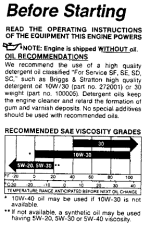
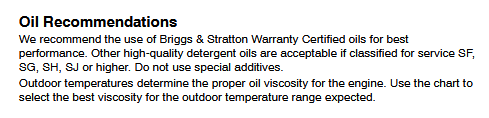
I pulled this from a common Briggs Quantum 111702-0166-01 single cylinder 190cc engine manual. Says use detergent oil. Millions of push mowers used this engine.
1778269740610.png

3.5hp Briggs horizontal shaft used on McLane Edgers for one example. Detergent oil again.
1778269836348.png

I've always heard no filter use non detergent oil. Briggs is saying otherwise??

And the lack of places to buy non detergent oils?

Got me wondering if I should be using it?
 
most of the small engines are calling for synthetic these days in a 10W-30 where the climate can be 40F in the morning and 95F during the day, or SAE30 if the temperatures are more moderate. I recently went thru the same question myself.

Do not use non-detergent oils in an engine that produces dirty oil. I used to re-machine and build engines for a living many years ago. When someone came in with an engine from pre-detergent oil days, say a 1936 Buick, we had to charge maybe an extra day's work to clean out all the oil lines, scrape the caked on dirt off everything to get it clean. Even the caustic parts washer with really hot water sprays would not clean it - and that washer would take paint off things when they were washed in it. I mention the 1936 Buick because I remember one so caked that it took me hours with long drill bits getting all the dirt out of them. Awful. Just awful. A typical small aircraft engine runs around 2100 to 2500 RPM in colder air than a mower. Most mowers limit the RPM based on the blade tip speed, and run somewhere between 3200 and 3600 RPM. Ironically, one can find basically the same engine with different HP ratings dependent upon what the final RPM is set to.
 
Last edited:
I have found that it benefits "no oil filter" engines to use straight SAE 30 engine oil. This way all of the break-in and wear particles (sludge) collects and remain in the bottom sump of the engine. These are "splash oiled" engines that use a "dipper" attached to the connecting rod cap.

Using detergent oils will not let the particles settle and they will constantly recirculate and accelerate engine wear. Splash oiled engines do not have an oil filter to catch the wear particles.

Engines that have an oil filter have an oil pump that circulates pressurized oil to the moving components inside the engine. Detergent oils actually benefit this design because the wear particles cannot settle and they get trapped by the oil filter.

Regardless, it is best to change the engine oil (and filter if equipped) at the beginning of every season or more often as recommended by the engine manufacturer.

Heavier oil does not mean better protection, that is an old man's myth that has existed for as long as I can remember. Heavier oils are only beneficial in constant high temperature environments.
 
"There are two things to consider when it comes to oil, first is if it doesn't have an oil filter or pump, then you need to run a non-detergent oil.
Most automotive oils are multi-weight. (5W-20, 10W-30, etc)
most non-detergent oils are straight weight oils. (20W, 30W and so on)"
That's bunk!
Non-detergent oils are mainly used for air compressors.
Single grade SAE XX HD are detergent oils and are compatible with internal combustion engines. SAE30HD motor oil was the gold standard for 4 stroke small engines for many years and they are still a good choice. It's best to follow the engine manufacturers recommendations.
 
I'd have to do some digging but somewhere I've got the original manual that came with my dad's old 1967 3hp Briggs & Stratton powered push mower. It explicity says "USE ONLY NON-DETERGENT MOTOR OIL" then gives a chart showing what oil to use in a particular temperature range.
It shows SAE 20ND below 32 °F, and from 33 to 90°F to use SAE30ND, and for Extreme duty or temps above 90, use SAE40ND
Its lived on nothing but Pennzoil SAE30 Non Detergent since it was new, it must have worked because I still mow my grass with it almost 60 years later. Dad is long gone but that mower is still going strong. Its been through a half dozen decks, but the same motor.

A lot of modern engines are now using hydraulic lifters so oil consistency is important to prevent damage from over pumped lifters. So they now recommend 10W30 synthetic in most over head valve engines. For the most part oil slingers are a thing of the past but on motors that used them and pure splash llubrication and no pump, no filter, good quality SAE 30 Non Detergent is fine, but the problem I find these days is its hard to find good SAE30 Non detergent oil. Most that I find these days is pure mineral oil, with no additives. In the past, just because it didn't contain any detergent additives, it did still contain various other needed additives. That doesn't appear to be the case now. If the choice is risk a detergent oil or run straight mineral oil, I'll chance the detergent oil, but so long as my dad's life time stash of SAE30 ND from the 1970's holds out, that's what goes in my older mowers.

I run the Walmart brand 10W30 synthetic oil in my Honda and Honda clone motors, and anything with hydraulic lifters.
I wouldn't think of using something that thin in my old cast iron Briggs 16hp in my Allis Chalmers 916H though. That gets SAE30 HD or the older ND oil.
 
Back
Top