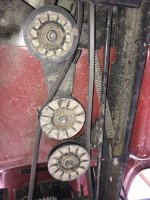
drive pulley

Being a 2013 model the things that come to mind is the groove in the engine pulley is getting worn/glazed preventing the belt from properly grabbing the sides of the belt instead of the bottoming out in the groove. And being a hydrostat transaxle in a lawn tractor, I would consider that to be the weak link for torque.
Yes, I agree that a 2013 model (bought used around 2016 and which has seen no pulley - of the 5 total that contact the belt - ever replaced as of now, that probably replacement of all 3-4 may be warranted. I have about 25,000 sq. ft. to mow with this tractor, and it has been very reliable in most all things to date - except the ability to pull anything with my body mass plus the slightest weight.

So bottoming the belt out in the groove in the drive pulley is desired, or not? I would think the pulley wall flanges worked in conjunction with the design of the v-belt to drive the pulley at it's 3 three surface contact points for max torque?

I've not fully examined the idler pulleys, but just as I am more worn out today since 2013, routine replacement of these pulleys seems warranted as well as a more proper maintenance approach.

Thank you for your input.
 

Attachments

  • Sears LT Dr. Belt 3-Mid Pulleys Photo.JPG
    Sears LT Dr. Belt 3-Mid Pulleys Photo.JPG
    2.6 MB · Views: 3
So bottoming the belt out in the groove in the drive pulley is desired, or not? I would think the pulley wall flanges worked in conjunction with the design of the v-belt to drive the pulley at it's 3 three surface contact points for max torque?

Thank you for your input.
Bottoming out is not desired. The belt is pulled by friction on the sides of the belt. The bottom of the belt making contact with the pulley creates a lifting effect that prevents the V sides from making proper contact. And in some cases the sides of the pulley will wear creating a hump where the bottom of the belt has been riding, and this will create the same effect as bottoming out in the groove.
 
If you do not already have one, search on-line and download a free OWNERS MANUAL for your rig using the EXACT model number. Most owners manuals tell you how to replace belts and make adjustments.
If the owners manual does not have a parts list, come back here and post up your EXACT model number and we can help you find parts.

You need to do an inspection first before ordering any parts, for example first remove the old drive belt.
 
Bottoming out is not desired. The belt is pulled by friction on the sides of the belt. The bottom of the belt making contact with the pulley creates a lifting effect that prevents the V sides from making proper contact. And in some cases the sides of the pulley will wear creating a hump where the bottom of the belt has been riding, and this will create the same effect as bottoming out in the groove.
Understood. I most probably will revert back to simply removing the OEM engine and transaxle pulleys, along with the flat idler, andv-idler (2) pulleys to examine for wear (and probably proactive replacement) along with springs and another new belt. Replacement parts, while seemingly inexpense, add up here, though, but all seem available.

I do still believe my idea for a geared or ribbed engine pulley and geared or ribbed transaxle pulley will, ultimately, give me more torque and less slippage than the OEM setup by a reasonable measure of magnitude. I may continue that concept deep-dive as a backup project, especially since metal 3D printing would yield a POC, strong proto (without CNC work) which I could then test and probably use, if successful. Thank you,
 

Attachments

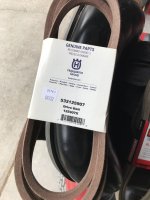
  • Sears LT (H Group) Drive Belt PN.JPG
    Sears LT (H Group) Drive Belt PN.JPG
    1.6 MB · Views: 1
If you do not already have one, search on-line and download a free OWNERS MANUAL for your rig using the EXACT model number. Most owners manuals tell you how to replace belts and make adjustments.
If the owners manual does not have a parts list, come back here and post up your EXACT model number and we can help you find parts.

You need to do an inspection first before ordering any parts, for example first remove the old drive belt.
Thanks. I've had an Operator's Manual for some time which covers the parent model no. 917.28852 (and by default) the .288526 (which I posted in my first post), and which is the tractor I have. I have also replaced the drive belt once before a few years back, etc. Other than the army ground crawling, it wasn't difficult.

What I was searching for was a drawing showing the engine pulley and transaxle pulley physical dimensions. So far, no other replies have mentioned if these are available and my search online has found nothing. Finding OEM parts is not difficult, starting with "Sears Parts Direct" as well. :>))
 
Back
Top