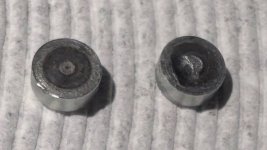
Mini engine parts broke this time

A sheared flywheel key on a rider engine usually does not happen unless someone left the flywheel bolt/nut too loose. flywheels are torqued down pretty tight.

On a fixed blade engine such as a push/ walk behind mower, it is much more common especially if an obstacle is hit with the mower blade. The inertia of the flywheel will quickly shear the aluminum key.

The only true way to make sure a flywheel key is not damaged is by physical inspection, other methods are a "close guess" at best.
Thank you Auto doc for replying I was also talking to someone regarding how this engine just shut down and they were saying unless you hit something where you forced the blade to stop all of a sudden in their opinion the keyway is okay since I didn't hit anything.

However inspecting the flywheel key visually there is no better way I see what you're saying taking shortcuts may lead to the wrong conclusions.
Jim
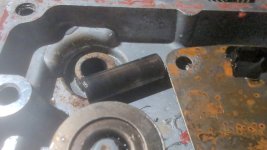
 
Just to make sure buying a replacement cylinder head is the correct thing to do does this picture confirm that this thing is completely broken. That valve guide fell right out of the sleeve or whatever it's supposed to hold it but that's not supposed to happen or is this piece is it supposed to come out like this where where you can lay it on the side.

Jim
 

Attachments

  • 17847474367373976810243309774962.jpg
    17847474367373976810243309774962.jpg
    506.2 KB · Views: 9
Just to make sure buying a replacement cylinder head is the correct thing to do does this picture confirm that this thing is completely broken. That valve guide fell right out of the sleeve or whatever it's supposed to hold it but that's not supposed to happen or is this piece is it supposed to come out like this where where you can lay it on the side.

Jim
So is that cylinder looking thing maybe it's an inch long is that the valve guide yes or no? I asked the question because I turned the cylinder head upside down and that thing falls out I'm under the impression it raises up a bit if that's the right thing it can't possibly just fall out so I'm thinking it is some other part?
 
That is the valve guide, and they should never move or come out of the head. They are tightly press fitted when installed new. The head was likely not machined properly when new. Mass production engines are not give the same attention to detail as an automotive engine.
 
That is the valve guide, and they should never move or come out of the head. They are tightly press fitted when installed new. The head was likely not machined properly when new. Mass production engines are not give the same attention to detail as an automotive engine.
Thank you, I was not aware that they could just fall right out.
 
They should never just fall out like that.
Okay so I've only seen three-cylinder heads in the last 20 years and I never saw one up close like that so when that piece fell out I wasn't sure if it was even a valve guide that's what happened I thought they could only somehow get raised that's why I sent the message in the first place I had no clue what that part was, but thanks for clearing up everything.
 
Hi J.,

Poor machine tolerances are the root cause if a valve guide actually falls out when the spring is removed.

Most of the time, the bad ones are still a snug fit and gradually move upward with hours of run time or repeat overheating due to grass/dirt choked cooling find.
 
Torque the head bolts to 20 Ft Lbs. in a criss cross pattern. Go in stages of 10, 15, then 20. This compresses the head gasket gradually and evenly to ensure a good seal.

Do not reuse the old head gasket because it has already been compressed and weakened due to age and heat cycles (throw it away).

The early B&S "tin foil" layered head gaskets on the flat head engine could be reused most of the time, but these newer soft composite head gaskets cannot.
Auto Doc I had to go back and take a look at what you wrote right here but I knew you wrote it this is excellent I'm at that stage right now where I'm putting the cylinder head back on the machine and I'm going very slowly especially with the numbers you have mentioned thanks again this is very helpful!!! And also the pattern from StarTech which is actually part of a printout from Briggs& Stratton same thing.
 
One week old valve cap has a dent in it + brand new push rods one of them weighs 20 g that's the intake push rod and then the other one weighs 40 g that would be the exhaust push rod however I have what's called the original exhaust push rod and is 50 g the interesting thing with the package of push rods I received yesterday is neither of them are attracted by a magnet whereas the 50 g push rod that I'm calling the original exhaust push rod is attracted by a magnet which makes sense so the first thing is a valve cap which is only one week old and pictured in this image has a dent in it and then the other issue is regarding the brand new 40 g exhaust push rod I was not aware you could use another material besides steel or an exhaust push rod.

So here's the actual questions

Is it typical for a 1-week-old valve cap to get a dent in it which you'll see in the photograph hopefully.

And the second question is, have manufacturers switched to something other than steel for an exhaust push rod?

In the setup I'm rebuilding today I will be using the 20 g aluminum push rod for the intake and then the original 50 g steel push rod which most likely came with the lts2000 Craftsman around 2010 I'm guessing.

Thanks,
Jim
 

Attachments

  • PXL_20260724_101729023.RAW-01.COVER.jpg
    PXL_20260724_101729023.RAW-01.COVER.jpg
    457.7 KB · Views: 8
Last edited:
Back
Top