
Mini engine parts broke this time

Don't mention coils here. This year has been a strange one. equipment comes in with working coils and they either die during repairs or shortly after the customer get the machines back. Must be a year for headache repairs here.

Just got back in a Z915B where the fuel system was a mess. The only know problem that the mower left with was #2 barrel of the carburetor was developing a little frost. Overnight it started popping and snapping out the exhaust on start ups and shutdowns. Looks like another set of coils failing again as it seems one or both is not firing under compression all the time so wasted spark is igniting the raw fuel in the exhaust.
 
Don't mention coils here. This year has been a strange one. equipment comes in with working coils and they either die during repairs or shortly after the customer get the machines back. Must be a year for headache repairs here.

Just got back in a Z915B where the fuel system was a mess. The only know problem that the mower left with was #2 barrel of the carburetor was developing a little frost. Overnight it started popping and snapping out the exhaust on start ups and shutdowns. Looks like another set of coils failing again as it seems one or both is not firing under compression all the time so wasted spark is igniting the raw fuel in the exhaust.
I can't possibly be jinxing you too, I have no time for that only myself. But for 20 yrs and 3 different riding the mowers the only thing that did not break is the ignition coil and this is all home use equipment. The current mower where the cylinder head is being replaced today, it has a muffler a "Husky" where I used the JB weld and it is useless, so maybe a new one of those soon. It is held together but not "airtight" like say a brand new one where the pipe flange meets the actual muffler portion. But I can say today I learned that placing the ignition coil "prongs" on center with the magnet on the flywheel should result in the piston almost TDC. I say it this way because I only want to know if the keyway is damaged and if the keyway is damaged AND this other test is true then that means this combination is like almost 0% therefore the keyway is good. If the prongs on the IC are centered over the flywheel magnet and at the same time the piston is say 1/2 down the cylinder walls then the keyway is broken. Anyways this is what I learned today not being in riding mower repair, so I quick test without needing to remove the flywheel bolt to see how the keyway is "doing"
Jim
 
No your not it just how things comes in bunches. Next year it can be a whole different set of repeat problems.
 
No your not it just how things comes in bunches. Next year it can be a whole different set of repeat problems.
But let me ask you a question regarding what I read is the test that I'm performing to see if the keyway is fine the way I described it is that exactly what you do? I mean I never did that before in the past I just took off the bolt for the flywheel but this seems like one step above brute force.

Thanks in advance,
Jim
 
Now I have read through all six pages so I haven't what procedure you described.

I very seldom run across a sheared key except on walk behinds; although, I come across a Briggs 31 series that use the old style setup but actually broke the flywheel key way as it sheared the key.

Most times all you need to do is remove the retaining nut and washer or bolt and look at the keyways alignment. Now some old engine that uses the starter clutch it has to come off to see.
 
Now I have read through all six pages so I haven't what procedure you described.

I very seldom run across a sheared key except on walk behinds; although, I come across a Briggs 31 series that use the old style setup but actually broke the flywheel key way as it sheared the key.

Most times all you need to do is remove the retaining nut and washer or bolt and look at the keyways alignment. Now some old engine that uses the starter clutch it has to come off to see.
StarTech I can only say in a time where you replied I went outside + what happened was and I did not remove that nut and washer because that means I got to put it back on and then I got to get a pipe wrench and all that stuff but anyways what I did was I got the Piston to top dead center and in doing so the ignition coil where it has those two prongs ended up being slightly behind that magnetic region on the flywheel another way to say it is I lined up those two prongs on the ignition coil so that it was perfectly on Center with the magnetic strip on the flywheel and I noticed the Piston was not at top dead center it was kind of close so because I rotated the flywheel clockwise to get the piston atop that Center means that magnetic strip on the flywheel ended up being slightly past where it just was if you can follow this.

Jim
 
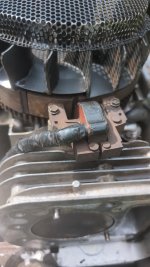
This is what it looks like from what I read this implies the keyway is perfect.


Or you're just really unlucky you got a broken keyway but it looks perfect.
 

Attachments

  • 17847313574753843852093422321938.jpg
    17847313574753843852093422321938.jpg
    773.5 KB · Views: 11
This is what it looks like from what I read this implies the keyway is perfect.


Or you're just really unlucky you got a broken keyway but it looks perfect.
So the first thing you do is you get the magnetic zone on the flywheel to be perfectly centered with respect to the ignition coil and then you notice the Piston is not at top that center so you rotate it clockwise and not very much, and then the piston is at top dead center. You then notice that magnetic zone has traveled slightly clockwise from where it was ,so my understanding is this implies the keyway is perfect I don't need to take off that bolt and the washer
 
One problem with that as the ignition has to fire a few degrees before TDC is why a shear key can give one heck of a kick back as it advances the ignition timing even more. I have had pull ropes jerk out my hand. Even take a week for my hand to recover.

And delayed timing will cause a lost power.
 
A sheared flywheel key on a rider engine usually does not happen unless someone left the flywheel bolt/nut too loose. flywheels are torqued down pretty tight.

On a fixed blade engine such as a push/ walk behind mower, it is much more common especially if an obstacle is hit with the mower blade. The inertia of the flywheel will quickly shear the aluminum key.

The only true way to make sure a flywheel key is not damaged is by physical inspection, other methods are a "close guess" at best.
 
Back
Top