Cylinder honing opinions

slomo

Lawn Pro
I know not much honing goes on anymore. But say back in the day, did you use the 3 legged flat stones or the ball type?

My deal is the 3 legged has again flat stones. We are honing a round bore. The ball hone seems to me, the better tool for the job.

If you hone say a knife or straight razor, you must dress or flatten your stones first. What do you guys think?

Square flat stones on a round bore???
 
Don't use a flex hone other than as glaze breaker. To resize cylinders you use a rigid hone with the correct stones.
 
So a ball hone is what you refer as a glaze breaker?

Just puzzles me why flat stones in a round bore for resizing. Seems to only make contact on the outer edge of the flats. No doubt they are very crude tools for the job.
 
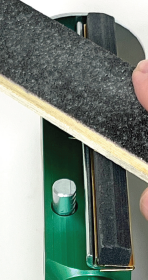
The stones are not flat but do have a double bevel although they may look flat.
1776841318085.png

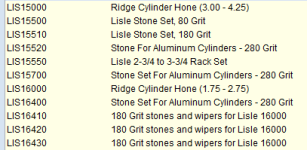
I use two Lisle hones here with different stones and racks. And they do require a heavy duty 1/2 drill. The engines do have to be bolted down as there is a lot torque involved; hence, why you use two hands on the drill.

1776840984145.png

https://www.lislecorp.com/specialty-tools/engine-cylinder-hone

Now these are not for 2 cycle ported cylinders. Ridge hones can hang on the ports. This where ball hones come in play. And most handheld 2 cycles don't have oversize pistons and rings available any way.

The reason for a ridge hone is that it removes oval and taper condition where a flex and ball hones just amplify these conditions.

And you will see why many DIYers don't have these hones. It is the price.
 
Anything with an aluminum bore i don't bother with. I do use a ball hone on cast iron liners to add a slight cross hatch to seat new rings in a std bore. Not worth trying to hone to oversize piston and rings.
 
Back in the 70’s, 80’s and early 90’s we had a contract with a large construction company to keep their generators and other equipment running. Rebuilt 25-30 generator K181 Kohler engines each season. I actually made a setup on the drill press to make things easier. Always used three different rigid hones with different sizes. Lots of kerosene and measuring. If reglazing was all that was needed, I would use the finest stone I had. Only used ball hone on aluminum cylinders.
 
I bored blocks for a living for a couple years. The first thing you need to do is inspect a cylinder, assess where it is at in diameter compared to the piston, and determine what you will be doing to it. If you are doing a ghetto or shade tree rebuild then it doesn't matter because someone will do whatever they want and tell a potential buyer they rebuilt the motor. But if you want a quality rebuild, and the piston and bore are in a good enough condition, you can resuse them. If so, and the bore is straight, just use a ball hone up and down at a speed where you can break any glaze and get a cross hatch. But if there is any uneveness in the bore, use a hone with 3 or 4 stones, even 2 will do if there are glides on the other two of four arms. When using a stone hone, the MOST important thing is to keep the stones straight. That means maintaining your speed and letting each end come just under 50% out of the bore and linger for a split second so the stone and bore stays straight. If one does not do that, the bore will get twice as many passed in the center and it will wear in a reverse hour glass figure. The stone will wear irregular and that will screw up the next jobs. You only want to use the stone enough to break the glaze if you are going to reuse the piston(s). Keep in mind that as the piston goes up and down, the rings wear. When new rings are used, their top edge is square. When it hits the ledge where the last ring ended, it can damage the ring, You have to improve that area. A ball hone is slightly more prone to wear that ledge back than a stone but it will not straighten out a cylinder any. Finding a shop to bore to fit oversize piston(s) on what was designed as a throw away engine is hard too. Not many places will touch them, other than a shop that specializes in racing carts.
 
A majority of the time a cylinder is only honed lightly to minimize or eliminate fine vertical scratches. Both types of hones will work satisfactory to get the desired "cross hatch" results, so I really think it is a matter of preference.

I have not resized an engine bore since the 70's and that was in an early cast iron Kohler engine. Most people will not pay the cost

Modern aluminum engine blocks are just not worth the expense of oversizing the cylinder bore(s), even if you can find a machine shop that is willing to even take the job in. It's expensive for a machine shop to setup the equipment to do the job correctly.
 
One of my first jobs was at an automotive machine shop. The place was in an area with lots of farms and big lawn properties. We had about 8 guys, each did a separate process on each motor, sort of assembly line style.

We would get small engines in all the time for which we used a boring bar on a mill and finished up with a wet hone.
The wet hone sat over a water tank, the spindle turned an eccentric fixed stone.
The block got bored according to the piston we were fitting.
There were stones for iron and stones for aluminum. Both were no problem but aluminum required a heat cycle and wash after final honing to what the boss called Tuffriding, the surface. The hone had a cart right on it for each engine, one for all the BS models, one for Lawson/Tecumseh, and one for Clinton.

The hone had three angled and adjustable stones that faced the cylinder wall, you set the stones to max depth of cut, so if the cylinder needed to go to say 3.00, you would set it to go to maybe 3.05 for the first round of cutting.You could walk away because it would only cut so far, it wasn't spring applied. you would set it to hone in small increments till you had a round, even bore. The fact that it was flooded with water while it ran kept the stones clean of debris. Back then I'd by motors all over the place and fit new pistons to them just to have for future use. I've still got a half dozen put away that I saved back then. Most are .010 or .020 oversize pistons with the rings fitted, but not installed. The boss didn't care that we did that because he saw it as good practice.

The owner would also buy out other shops that were doing the same work, so we had a huge supply of misc parts on hand that were even then too old to be hot sellers, so he didn't mind if we helped our selves either. The one thing I wish I had done was buy the equipment when they closed down in them mid 90's I had been out of there for 15 years and most of the machine shop had been dormant since the early 80's when I left. They had moved away from small engine work by then and the equipment just sat. I would have loved to had the boring bar, Bridgeport mill, lathe, and wet hone for myself but I suppose they went for more than I'd have ever paid for them.

 
Hello V.,

Materials and procedures have changed dramatically since.

Sadly, people today do not understand the finer points of actual machine work such as boring or resizing a crank and rod journal. The setup alone would make them run away.

Now they think running a hone down a cylinder on their backyard workbench is magically "resizing" the bore. Armchair science is far from reality.
 
Back
Top