CH20s "throttles back" from full occasionally, then returns to full throttle

Mfb

Forum Newbie
Good day, all.
One consequential and 1 “unfortunate” issue begging for insight here.

I'm the original owner of a Kohler CH20S, SPEC NO. 64586, SERIAL NO. 2807219481, FAMILY: SKH624U1G2RA in a deere F620 with 326hrs on it.
She’s been a champ until about 4 years ago, when full throttle mowing (at varying ambient temperatures and few extreme loads) would randomly create a < 60 second “throttle down” maybe 1 or 2 times during SOME 45-minute mowing sessions.
Other than this occasional condition, It's had 0 popping/smoking/stalling/loping, or other bad behaviors.
EVERY TIME so far, when the “idle down” occurs, it’ll spin back up after some number of seconds, and some/most times, engine won't miss a beat for whole session .
When it "throttles down", Engine SEEMS to be running on 2 (smooth spin) cylinders, no fuel smoke, no detectable “lean” cutouts.
Pulling the choke wants to kill it all the way.
Seems cycling blade clutch on/off any number of times doesn’t correspond with seem to restore full power.
Sometimes, it seems like disengaging the blade clutch, then briefly reducing throttle to 0, then back to full brings it all back, which persists through the blade re-engagement and mowing.
Episodes have all been so short that I can't get off mower, lift lid, and pull plug wires fast enough to see if one wasn’t firing.

Soliciting ideas for logic to explain and next steps to take.

To date:
-It’s never failed to start & run reliably with full power after anything but a few rotations and few seconds of choke (if that much).
-Verified fuel tank vent flowed air.
-Verified that fuel pump was delivering good stream through clean filter.
-Seemed that charging system had weakened over time, only charging to ~12.4v. Verified good stator, found regulator part # (WAY too hard, since i only found 1 OEM part diagram that PICTURED my old unit, but didn’t give it’s part #, and the universe seems to have at least 2 dozen “probably right” part numbers that might/might not fit shroud cutout), which is now charging to 14.4v on full-wave rectifier with OVP.
-Discovered some minor binding at governor linkage arm, removed, inspected, cleaned, adjusted, verified operation. (nearly went insane trying to replace the 8mm nylon lock nut beneath the linkage arm stack without removing engine or a lot of stuff from backside)
-plugs look pretty nice to me- clean, not ashy, .030 gap.

About the only benign test, for real-time execution, i can think of::
Remove the front shroud ignition coil covers (with the horizontal shaft, haven't been able to see how to remove flywheel shroud without removing engine), and Try to disconnect kill wire at coils, tie them up someplace, and run a couple new wires to some kind of instantly-accessible console that i can used to short coil kills independently (to see if toggling 1 doesn’t matter & the other kills it, within the few seconds it’s “throttled down” when throttle set to "full")

Anyone with better ideas to track this gremlin down?

The other “unfortunate” issue:
“Discharge indicator” light shines ALWAYS.
Would like to figure out how to replace with grandpa-style ammeter, but haven’t found that right answer yet.

Thank you in advance for your time & consideration.
 
Good day, all.
One consequential and 1 “unfortunate” issue begging for insight here.

I'm the original owner of a Kohler CH20S, SPEC NO. 64586, SERIAL NO. 2807219481, FAMILY: SKH624U1G2RA in a deere F620 with 326hrs on it.
She’s been a champ until about 4 years ago, when full throttle mowing (at varying ambient temperatures and few extreme loads) would randomly create a < 60 second “throttle down” maybe 1 or 2 times during SOME 45-minute mowing sessions.
Other than this occasional condition, It's had 0 popping/smoking/stalling/loping, or other bad behaviors.
EVERY TIME so far, when the “idle down” occurs, it’ll spin back up after some number of seconds, and some/most times, engine won't miss a beat for whole session .
When it "throttles down", Engine SEEMS to be running on 2 (smooth spin) cylinders, no fuel smoke, no detectable “lean” cutouts.
Pulling the choke wants to kill it all the way.
Seems cycling blade clutch on/off any number of times doesn’t correspond with seem to restore full power.
Sometimes, it seems like disengaging the blade clutch, then briefly reducing throttle to 0, then back to full brings it all back, which persists through the blade re-engagement and mowing.
Episodes have all been so short that I can't get off mower, lift lid, and pull plug wires fast enough to see if one wasn’t firing.

Soliciting ideas for logic to explain and next steps to take.

To date:
-It’s never failed to start & run reliably with full power after anything but a few rotations and few seconds of choke (if that much).
-Verified fuel tank vent flowed air.
-Verified that fuel pump was delivering good stream through clean filter.
-Seemed that charging system had weakened over time, only charging to ~12.4v. Verified good stator, found regulator part # (WAY too hard, since i only found 1 OEM part diagram that PICTURED my old unit, but didn’t give it’s part #, and the universe seems to have at least 2 dozen “probably right” part numbers that might/might not fit shroud cutout), which is now charging to 14.4v on full-wave rectifier with OVP.
-Discovered some minor binding at governor linkage arm, removed, inspected, cleaned, adjusted, verified operation. (nearly went insane trying to replace the 8mm nylon lock nut beneath the linkage arm stack without removing engine or a lot of stuff from backside)
-plugs look pretty nice to me- clean, not ashy, .030 gap.

About the only benign test, for real-time execution, i can think of::
Remove the front shroud ignition coil covers (with the horizontal shaft, haven't been able to see how to remove flywheel shroud without removing engine), and Try to disconnect kill wire at coils, tie them up someplace, and run a couple new wires to some kind of instantly-accessible console that i can used to short coil kills independently (to see if toggling 1 doesn’t matter & the other kills it, within the few seconds it’s “throttled down” when throttle set to "full")

Anyone with better ideas to track this gremlin down?

The other “unfortunate” issue:
“Discharge indicator” light shines ALWAYS.
Would like to figure out how to replace with grandpa-style ammeter, but haven’t found that right answer yet.

Thank you in advance for your time & consideration.
Hello M.,

This mower was only built in '98-'99. Nice machines before the zero turns really became popular.

The most likely issue that you are dealing with is an aged mix of fine sediment and moisture globs (dirty water) floating around in the bottom of the fuel tank. This stuff takes many years to collect in fuel the tank and is commonly missed or ignored by people that think pour in additives will clear it up. The only true way to clear it is to remove the fuel tank and clear it out, then flush it with soap and water.

This stuff floats around and slowly gets drawn in with the fuel at random times. Many unexplained running problems that come and go often start inside the fuel tank.

Years ago, I was a service manager for a local JD dealer and had the pleasure of working on many of these machines alongside my techs when they ran into troubles they could not figure out.

Another likely issue that creates occasional power loss is an ignition coil with failing windings. This is a very subtle problem that comes and goes without the traditional misfire, and the engine will not shake or rock because it is solid mounted and well balanced physically.

The constant charge light is possibly an inline diode block that was used around the time this mower was built. Deere had a lot of issues with them back then or the wrong charging regulator being used.

I do not currently have a wiring diagram to reference for this mower. It would help us to know the PIN number that is on the chassis label.
 
Last edited:
  • Like
Reactions: Mfb
Hello M.,

This mower was only built in '98-'99. Nice machines before the zero turns really became popular.

The most likely issue that you are dealing with is an aged mix of fine sediment and moisture globs (dirty water) floating around in the bottom of the fuel tank. This stuff takes many years to collect in fuel the tank and is commonly missed or ignored by people that think pour in additives will clear it up. The only true way to clear it is to remove the fuel tank and clear it out, then flush it with soap and water.

This stuff floats around and slowly gets drawn in with the fuel at random times. Many unexplained running problems that come and go often start inside the fuel tank.

Years ago, I was a service manager for a local JD dealer and had the pleasure of working on many of these machines alongside my techs when they ran into troubles they could not figure out.

Another likely issue that creates occasional power loss is an ignition coil with failing windings. This is a very subtle problem that comes and goes without the traditional misfire, and the engine will not shake or rock because it is solid mounted and well balanced physically.

The constant charge light is possibly an inline diode block that was used around the time this mower was built. Deere had a lot of issues with them back then or the wrong charging regulator being used.

I do not currently have a wiring diagram to reference for this mower. It would help us to know the PIN number that is on the chassis label.
I agree. Either crap in fuel tank or slowly failing coils. I have this exact mower at my shop right now from customer. Has sticking valves and won’t start/run and waiting for him to come pick this old antiquated hunk of junk up (been paid).
 
  • Like
Reactions: Mfb
Hello M.,

This mower was only built in '98-'99. Nice machines before the zero turns really became popular.

The most likely issue that you are dealing with is an aged mix of fine sediment and moisture globs (dirty water) floating around in the bottom of the fuel tank. This stuff takes many years to collect in fuel the tank and is commonly missed or ignored by people that think pour in additives will clear it up. The only true way to clear it is to remove the fuel tank and clear it out, then flush it with soap and water.

This stuff floats around and slowly gets drawn in with the fuel at random times. Many unexplained running problems that come and go often start inside the fuel tank.

Years ago, I was a service manager for a local JD dealer and had the pleasure of working on many of these machines alongside my techs when they ran into troubles they could not figure out.

Another likely issue that creates occasional power loss is an ignition coil with failing windings. This is a very subtle problem that comes and goes without the traditional misfire, and the engine will not shake or rock because it is solid mounted and well balanced physically.

The constant charge light is possibly an inline diode block that was used around the time this mower was built. Deere had a lot of issues with them back then or the wrong charging regulator being used.

I do not currently have a wiring diagram to reference for this mower. It would help us to know the PIN number that is on the chassis label.
thank you very much for prompt reply.
PIN is Serial Number *TCF620X010026*.
I agree. Either crap in fuel tank or slowly failing coils. I have this exact mower at my shop right now from customer. Has sticking valves and won’t start/run and waiting for him to come pick this old antiquated hunk of junk up (been paid).
"this old antiquated hunk of junk"... you're sounding more like wife talking about me than my mower ;-}
posting reply to @Auto Doc's soon as i can get more together. thanks.
 
I agree. Either crap in fuel tank or slowly failing coils. I have this exact mower at my shop right now from customer. Has sticking valves and won’t start/run and waiting for him to come pick this old antiquated hunk of junk up (been paid).
Hello M.,

Put some Marvel Mystery oil in the engine oil and the gasoline. About a 1/2 pint in each should do well. This will dissolve the oil sludge that has built up over years of use. It works wonders for freeing up the sticky piston rings also.

Read up about MM oil if you are not already familiar with it. It is one of the few (snake oil) products that does what it claims.
 
Hello M.,

Put some Marvel Mystery oil in the engine oil and the gasoline. About a 1/2 pint in each should do well. This will dissolve the oil sludge that has built up over years of use. It works wonders for freeing up the sticky piston rings also.

Read up about MM oil if you are not already familiar with it. It is one of the few (snake oil) products that does what it claims.
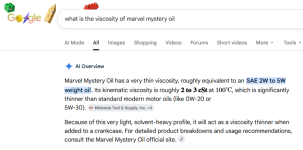
I wouldn't add anything but a good SAE 30W if it was MY mower. Marvel has solvents and a thin base oil that will degrade the viscosity. Maybe if she was water cooled?? A good oil is critical as well as CLEAN cooling fins.
 
I wouldn't add anything but a good SAE 30W if it was MY mower. Marvel has solvents and a thin base oil that will degrade the viscosity. Maybe if she was water cooled?? A good oil is critical as well as CLEAN cooling fins.
Hi Slomo,

MM oil is not meant to remain permanently in the engine, just a few hours of run time so it can dissolve the sticky carbon.

Marvel Mystery Oil is primarily made of petroleum distillates, including mineral oil, mineral spirits, and small amounts of chemical additives like tricresyl phosphate and chlorobenzenes.

Marvel Mystery Oil, developed in 1923 by Burt Pierce, is a petroleum-based automotive additive used in fuel, motor oil, and other lubricants for cleaning, lubrication, and corrosion prevention, although scientific evidence for its claimed benefits is limited WikipediaWikipedia+1. Its composition is primarily petroleum distillates:

  • Mineral oil (60–100%): Acts as a lubricant to reduce friction and wear in engine components WikipediaWikipedia+1.
  • Mineral spirits/Stoddard solvent (10–30%): Serves as a cleaning agent to dissolve carbon deposits and other contaminants WikipediaWikipedia+1.
  • Tricresyl phosphate (0.1–1%): An anti-wear and extreme pressure additive that helps protect metal surfaces under high stress WikipediaWikipedia+1.
  • Ortho-dichlorobenzene (0.1–1%): Softens and removes carbon-based deposits on metal surfaces WikipediaWikipedia+1.
  • Para-dichlorobenzene (<0.1%): Used as a precursor in chemical processes and contributes minor cleaning or solvent properties WikipediaWikipedia+1.
    Some historical formulations, such as those reported in aircraft investigations, included lard (1%) along with mineral oil and Stoddard solvent, though modern formulations focus on petroleum distillates WikipediaWikipedia. The product also contains volatile organic compounds (over 24%), which can pose health risks if inhaled in large quantities JalopnikJalopnik.
    Marvel Mystery Oil is marketed for multiple uses: as a fuel additive to improve combustion, as an oil additive to reduce engine wear, and as a penetrating oil for loosening rusted parts. While it has been popular for older carbureted engines, contemporary engine designs often do not require such additives, and manufacturers like Ford and GM advise against their use in modern engines WikipediaWikipedia+2.
    In summary, Marvel Mystery Oil is a blend of mineral oil, solvents, and trace chemical additives designed for lubrication, cleaning, and corrosion prevention, with its exact formulation historically kept somewhat proprietary, hence the "mystery" in its name WikipediaWikipedia+1.
Read less
https://www.bing.com/ck/a?!&&p=7186...WEub3JnL3dpa2kvTWFydmVsX015c3RlcnlfT2ls&ntb=1
 
My take, on a 27 year old engine, she needs some love.

1.Valves clearances ran
2.All cylinders de-carboned per yours and every other mower engine manual out there. Should be done say every 5-9 years depending on usage. Look at your engine manual to find out more.
3.Number 2 leads to number 3. Valves lapped in. Nice valve job is critical.
4.3 to 4, head and block area where head sits needs lapped along with a fresh head gasket.

5.Agree with the guys, flush the fuel tank like a new one. Verify good flow out of with a simple clear vinyl hose. Use Diesel to flush with. Way less flammable than gas. Everyone should have a can of Diesel for cleaning parts and carbs with. Cheaper than brake cleaner and way less toxic on the lungs.

6.New fuel lines from tank to carb inlet.
7.Verify a fat solid fuel stream AT the carb inlet.
 
Hi Slomo,

MM oil is not meant to remain permanently in the engine, just a few hours of run time so it can dissolve the sticky carbon.

Marvel Mystery Oil is primarily made of petroleum distillates, including mineral oil, mineral spirits, and small amounts of chemical additives like tricresyl phosphate and chlorobenzenes.

Marvel Mystery Oil, developed in 1923 by Burt Pierce, is a petroleum-based automotive additive used in fuel, motor oil, and other lubricants for cleaning, lubrication, and corrosion prevention, although scientific evidence for its claimed benefits is limited WikipediaWikipedia+1. Its composition is primarily petroleum distillates:

  • Mineral oil (60–100%): Acts as a lubricant to reduce friction and wear in engine components WikipediaWikipedia+1.
  • Mineral spirits/Stoddard solvent (10–30%): Serves as a cleaning agent to dissolve carbon deposits and other contaminants WikipediaWikipedia+1.
  • Tricresyl phosphate (0.1–1%): An anti-wear and extreme pressure additive that helps protect metal surfaces under high stress WikipediaWikipedia+1.
  • Ortho-dichlorobenzene (0.1–1%): Softens and removes carbon-based deposits on metal surfaces WikipediaWikipedia+1.
  • Para-dichlorobenzene (<0.1%): Used as a precursor in chemical processes and contributes minor cleaning or solvent properties WikipediaWikipedia+1.
    Some historical formulations, such as those reported in aircraft investigations, included lard (1%) along with mineral oil and Stoddard solvent, though modern formulations focus on petroleum distillates WikipediaWikipedia. The product also contains volatile organic compounds (over 24%), which can pose health risks if inhaled in large quantities JalopnikJalopnik.
    Marvel Mystery Oil is marketed for multiple uses: as a fuel additive to improve combustion, as an oil additive to reduce engine wear, and as a penetrating oil for loosening rusted parts. While it has been popular for older carbureted engines, contemporary engine designs often do not require such additives, and manufacturers like Ford and GM advise against their use in modern engines WikipediaWikipedia+2.
    In summary, Marvel Mystery Oil is a blend of mineral oil, solvents, and trace chemical additives designed for lubrication, cleaning, and corrosion prevention, with its exact formulation historically kept somewhat proprietary, hence the "mystery" in its name WikipediaWikipedia+1.
Read less
https://www.bing.com/ck/a?!&&p=71868e872dc141ef0901d7e4f1e905ee3bf82eae515e36681ffccf9d2c1cef19JmltdHM9MTc4MDUzMTIwMA&ptn=3&ver=2&hsh=4&fclid=0a8004ae-14d8-61ea-2860-13e7159860fd&psq=what+is+Marvel+Mystery+oil+made+of?&u=a1aHR0cHM6Ly9lbi53aWtpcGVkaWEub3JnL3dpa2kvTWFydmVsX015c3RlcnlfT2ls&ntb=1


I will keep it out of my engines. Do as you guys wish in yours.


1780607403354.png
 

Attachments

  • 1780607368620.png
    1780607368620.png
    75.7 KB · Views: 0
Hello M.,

Put some Marvel Mystery oil in the engine oil and the gasoline. About a 1/2 pint in each should do well. This will dissolve the oil sludge that has built up over years of use. It works wonders for freeing up the sticky piston rings also.

Read up about MM oil if you are not already familiar with it. It is one of the few (snake oil) products that does what it claims.
I have used Marvel Mystery Oil before and am familiar with the product. The mower has been picked up and I have been paid.
Kohler Command engine with hydraulic lifters. I was not going in any deeper on this repair. Was not cost effective to keep polishing this turd for the customer.
 
Back
Top