Export thread

Briggs engine on Toro recycler mower is possessed

#1

B

bwright1818

I have the above mower. Not sure what model Briggs it is, but it has the automatic choke connected to the muffler, with a control rod. Symptoms vary. Sometimes it starts and runs. Sometimes it doesn't start. When it does run, it will sometimes go until I have to empty the bag, then it won't restart. Other times it runs for varying lengths of time, then begins to misfire, getting worse and worse until it quits....BUT, if it's in this mode, if I stop pushing the mower, it smooths out for awhile. It seemed to me like the coil was failing, so I found a used one on eBay for ten bucks. This SEEMED to work better for awhile, but then it started causing problems again. I had noted that there had been a number change on the coil, so I bought a brand new one for $32 from Partstree. This included a new stop wire, which I installed. It started and stopped as a test, about ten times, flawlessly. Then, when I went to actually mow with it, it wouldn't start at first, then started, ran well for a few minutes, then started misfiring randomly for awhile and quit, with the same condition as originally occurred, where it would run better for a while if I stopped pushing it. I should just throw this thing in the dump; but now, it's personal. Any ideas welcome.


#2

R

Rivets

Sounds to me like you have a fuel or ignition problem. Will need to do a little troubleshooting to figure out which. This is what I would do if it came to me. Get yourself an inline spark tester and the next time you can’t get it started attach the tester and check to see if you have spark. If you have spark you probably have a fuel problem. If this is the case I suspect the float needle or seat has swelled and this will result in a lean starting and running condition. If you have no spark you have an ignition problem. When you replaced the coil did you set the air gap at .010”? Let us know what you find and post back with the model and serial numbers for the mower and we’ll tell you how to proceed.


#3

H

hlw49

Check the kill wire where it goes into the kill terminal to make sure it is opening enough not cause this problem.


#4

A

Auto Doc's

Pull the upper fan shroud, then operate the stop/go lever while watching the bracket at the flywheel brake where the cable attaches to it. The shut off switch is there also.

After years of use, the cable stretches slightly, and the cable retainer tends to give a little bit. All of this will randomly ground the cutoff switch at odd times.


#5

B

bwright1818

Thanks guys. I find that much like some of the Yamaha outboard engines I have worked on, the spark is barely visible, even when it's there. On a Yamaha, you hear it more than you see it. I do have a spark checker and sometimes I see it, sometimes I don't...but when it's there, it is hair thin at best. Thus I am not really confident about whether there is spark or not. My wife can't pull it hard enough for me to get my face down near the checker. I DO suspect something with the shut off. I will look into that. Maybe I will run it with the stop wire off of the kill mechanism and see if it runs reliably. I am a big-time Lawnboy two-stroke fan, so yes, I have plastic 0.010" shim stock that I set the coil with.


#6

R

Rivets

Please post model and serial numbers for the unit.


#7

A

Auto Doc's

Hi Rivets,

If it like the one I have, the chassis model and serial numbers are hidden behind the rear deck flap where the bagger attaches. (Toro hid them)

"B",

The engine should have the stamped numbers in the valve cover, or they will be laser etched on the side of the block (opposite side from the carburetor)


#8

sgkent

sgkent

what Autodoc says could explain it, or running lean. Engines die when a load is put on them and they are too lean. The condition can be carb caused, air leak on a manifold especially if it has a plastic manifold that cracked, or a loose head.


#9

R

Rivets

Hey Doc, I worked at Toro dealerships since the early 80’s and know where the unit numbers are located. Depending on model, there were at least 12 different engines used, depending on model and how old the model is. The engine numbers are located in one of 3 places. On the flap over the muffler, one the valve cover or laser etched into the side of the block. Without numbers we don’t know which engine he has and are only guessing the cause of the problem. Ball is in his court, we’ll see what he does.


#10

B

bwright1818

Well, I feel like a bit of a dummy. I should have thought of this FIRST, but the way it misfired, it just sounded more definite on-off, than fuel. I ran it with the kill mechanism disconnected and it ran the same...bad to none. So, I figured it was fuel. I started taking off the carb. I removed the fuel tank, using a clamp on the hose to save the fuel. While holding it in my hand, I took the pinch clamp off....and not a single drop of gas came out. I mean not a drop. I loosed the cap and fuel came out as you would think it should. I put it all back together and ran it with the cap loose and it seemed to run well. I think this is some kind of fancy EPA cap, because there is no obvious vent hole in it. It doesn't seem like you can take it apart, either. I order a new cap, cheap enough. Has anybody ever tried to take one apart? I think the choke control rod wasn't bent quite right, either.


#11

R

Rivets

This style of gas cap has been used for years and vents through the threads. Just like caps with a hole in the top they do go bad or get plugged. I question whether the choke rod has been bent unless you have been playing with it. Finally, why are you secretive about supplying us with the model and serial numbers. Makes me think you may be in over your head and need us to bail you out. Either way it would have been a lot easier if you would help the technicians with those numbers. Wait, I’ll stop my rant about DIY guys who know more than I do.


#12

B

bwright1818

Point taken. I will post the actual engine numbers later today. For now, when I looked up parts under the TORO number, it says the engine used on the mower is 104M020010F1. That's the number I used to look up a cap. As for being a DIY guy, I would love to bring it to a shop and have someone fix it, while I sip a margarita. But just rolling this thing into a shop would already exceed the used value of the thing. And I certainly can't afford $500 for a new one.


#13

StarTech

StarTech

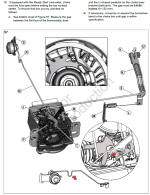
Ready choke check and adjustment procedure. Note this is done on a cold engine.

1763299095041.png


#14

B

bwright1818

Thanks for the diagram!! While I didn't actually measure, I am sure that gap range is about what I accomplished. I was given this mower, which seemed really clean but was reported to have a running problem. Today I looked over the cap and even pried it apart. No vent. No apparent vent in the threads. Interweb shows a similar tank with a vent to the intake, but this mower doesn't have that. I don't think there is a vent in either the tank OR the cap. If the new cap doesn't have a vent, I will just drill a tiny hole or two in the cap in a good place.


#15

R

Rivets

No matter what you say, the cap is vented through the threads. Now I know you are a DIY guy who is in over his head when you say I’m going to drill holes in your cap. For your information 104M020010F1 is the engine numbers. 104M02-0010-F1, just missing the code number.


#16

B

bwright1818

Yup, you bet, this is way over my head. I am such a moron. You're right. On a free lawnmower, it's really kinda the shallow end of the pool, though, you know? Not really worried about it.


#17

StarTech

StarTech

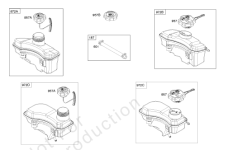
There is actually two OEM versions of this tank. The caps use on one of right side are not vented hence the tank vent. One on the left has external threading and the one on right has internal thread which is not actual threading. I do have the cap here in stock and there no way it can vent.
1763385869834.png


#18

A

Auto Doc's

Thanks for the diagram!! While I didn't actually measure, I am sure that gap range is about what I accomplished. I was given this mower, which seemed really clean but was reported to have a running problem. Today I looked over the cap and even pried it apart. No vent. No apparent vent in the threads. Interweb shows a similar tank with a vent to the intake, but this mower doesn't have that. I don't think there is a vent in either the tank OR the cap. If the new cap doesn't have a vent, I will just drill a tiny hole or two in the cap in a good place.
Hello B.,

Remove the air cleaner and operate the governor rod on top by hand. Watch the plastic lever end for hitting or hanging on the left side (looking at the carburetor inlet opening end). B&S had a shop bulletin on this a while back for this carburetor design.


#19

B

bwright1818

Hello B.,

Remove the air cleaner and operate the governor rod on top by hand. Watch the plastic lever end for hitting or hanging on the left side (looking at the carburetor inlet opening end). B&S had a shop bulletin on this a while back for this carburetor design.
Thank you. I will do that!
As for the tank, the pictures are interesting. It looks like the internal-thread tank has the vent nipple to the air cleaner housing. My engine has internal threads but no nipple.


#20

W

wink89801

I have also found that all of the mowers no matter the brand that have an auto choke have a tendency for the butterflies to close whenever they want even if the mower is warmed up. And if the mower has a kill when you empty the bag it can be quite a hassle to pull the breather, stick something in the carb to hold the butterfly open to restart it. To combat this, I take a stiff piece of wire (like a pin flag) cut and bend it to roughly 90°, attach it to the carb mounting screws and use the bent end to hold the butterfly open. Yes you may have to pull the rope a few times extra to start it cold, but after it's warm..no problems. I have owned a lawn care company for 17 years and started with Toro Recyclers as they were cheaper, and had that problem with all of them. Have since swapped them out with Hondas. They had the same problem. I despise auto-chokes. Used the same trick, they run like crazy.
Not saying that this is your problem, just something to consider. Good luck.


#21

C

Chipg1956

On these mowers I have seen the choke rod getting bent and binding on the cover. I have also seen where the metal tab between the muffler and the thermostatic unit has been bent throwing the choke adjustment off.


#22

B

bwright1818

I have also found that all of the mowers no matter the brand that have an auto choke have a tendency for the butterflies to close whenever they want even if the mower is warmed up. And if the mower has a kill when you empty the bag it can be quite a hassle to pull the breather, stick something in the carb to hold the butterfly open to restart it. To combat this, I take a stiff piece of wire (like a pin flag) cut and bend it to roughly 90°, attach it to the carb mounting screws and use the bent end to hold the butterfly open. Yes you may have to pull the rope a few times extra to start it cold, but after it's warm..no problems. I have owned a lawn care company for 17 years and started with Toro Recyclers as they were cheaper, and had that problem with all of them. Have since swapped them out with Hondas. They had the same problem. I despise auto-chokes. Used the same trick, they run like crazy.
Not saying that this is your problem, just something to consider. Good luck.
Thanks for that info! I don't seem to have a problem restarting mine yet, but that's really good to know. So, this picture was ultimately my running solution. The thing runs beautifully, now. In the picture, you can see a 1/16" hole in the middle and one on the outer perimeter. I drilled these two myself. The new cap I got had no vent in it, either. The tank has no vent, so I really think I had a mismatched setup. The cap is hollow and two-piece. the two holes let the tank vent from the tank to the outside, passing the air through the hollow part of the cap. You don't see any hole when the cap is installed. Now if I can just stop the grass and leaves from blasting out at the inside of the right front wheel.....

Attachments


Top