So the Cone is at the Other edge. 3/16" difference from centre.. Still centre of weight distrubution. It's not the Space Shuttle per "Terryl". !
Tell ya what.....drive a big spike into that beam and hang a tire and wheel assembly from the lug nut/stud hole....betcha it "balances" every time.
Today's lesson in "rocket science"....
Does the force at the end of a mower blade inctease linearly with rpm
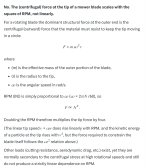
No. The (centrifugal) force at the tip of a mower blade scales with the square of RPM, not linearly.For a rotating blade the dominant structural force at the outer end is the centrifugal (outward) force that the material must resist to keep the tip moving in a circle:F=m ω2 rF = m\,\omega^{2}\,rF = m\,\omega^{2}\,r
where (m) is the effective mass of the outer portion of the blade,
(r) is the radius to the tip,
ω\omega\omega
is the angular speed in rad/s.
RPM ((N)) is simply proportional to ω\omega\omega
(ω=2πN/60\omega = 2\pi N/60\omega = 2\pi N/60
), soF∝N2.F \propto N^{2}.F \propto N^{2}.
Doubling the RPM therefore multiplies the tip force by four.(The linear tip speed v=ωrv = \omega rv = \omega r
does rise linearly with RPM, and the kinetic energy of a particle at the tip rises with v2v^{2}v^{2}
, but the force required to constrain the blade itself follows the ω2\omega^{2}\omega^{2}
relation above.)Other loads (cutting resistance, aerodynamic drag, etc.) exist, yet they are normally secondary to the centrifugal stress at high rotational speeds and still do not produce a strictly linear dependence
on RPM.
Knowing this, what would be the imbalance at the end of a 20" mower blade given a 1/8th oz higher weight at one end of the blade?
Thought for 24s
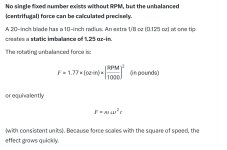
No single fixed number exists without RPM, but the unbalanced (centrifugal) force can be calculated precisely.A 20-inch blade has a 10-inch radius. An extra 1/8 oz (0.125 oz) at one tip creates a static imbalance of 1.25 oz-in.The rotating unbalanced force is:F≈1.77×(oz-in)×(RPM1000)2(in pounds)F \approx 1.77 \times (\text{oz-in}) \times \left(\frac{\text{RPM}}{1000}\right)^{2} \quad \text{(in pounds)}F \approx 1.77 \times (\text{oz-in}) \times \left(\frac{\text{RPM}}{1000}\right)^{2} \quad \text{(in pounds)}
or equivalentlyF=m ω2 rF = m\,\omega^{2}\,rF = m\,\omega^{2}\,r
(with consistent units). Because force scales with the square of speed, the effect grows quickly.Typical values for a lawn-mower bladeMost walk-behind and riding mowers run the blade in the 3000–3600 RPM range (tip speeds kept under the ANSI limit of ~19 000 ft/min).RPM
Unbalanced force
3000
≈ 20 lb
3200
≈ 23 lb
3600
≈ 29 lb
So a mere ⅛ oz difference at the tip of a 20-inch blade produces roughly 20–30 pounds of shaking force at normal operating speed. That is why even small imbalances cause noticeable vibration, premature bearing wear, and can be dangerous.If you know the exact RPM of your mower, plug it into the formula above for a more precise figure.
That's 3.54 grams......
Cleaned up....