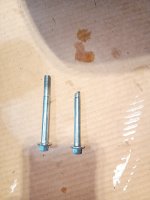
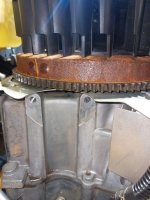
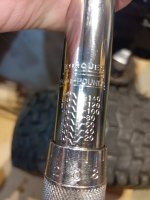
So I bought the Cub Cadet XT1 with a Kohler 7000 series engine that I had asked about in another thread a couple weeks ago that needed a new starter. The new OEM starter arrived today so I figured I'd do the 15 minute job of installing the new starter before dinner. Things didn't go as planned.... I installed the starter and snugged the bolts to what I thought was adequate but then made the fateful decision to Google the proper torque for the starter bolts, 15-18 ft lbs. So I got out the torque wrench and proceeded to tighten to proper torque. My gut was telling me to stop tightening, as it seemed well beyond adequate, but the steel bolts were still turning fairly easily in the aluminum engine and then SNAP. My 67 year old eyes with cataracts were having trouble reading the numbers on the torque wrench when I set the torque, and it turns out that I set the torque using the top line next to the 10 instead of the bottom line, so instead of setting it to 16 ft lbs it was more like 28. There is no stub of the bolt sticking out of the hole and the bolt sheared at an angle, so now getting the broken bolt out is above my pay grade. (some of you would argue that the simple task of installing the new starter was apparently above my pay grade... ARGG). So is this something that my local lawn mower repair shop should be able to handle easily? Is it possible to get a nut welded onto the sheared bolt inside the hole and just back it out or will it need drilled? I'm guessing I may have damaged the threads in both holes by tightening the bolts so tight and both may now need heli-coils? (I had stopped tightening the left bolt because I was getting worried the bolt would snap and was giving the right side one final snug when it snapped). What should I expect this will cost to have repaired? The picture of the torque wrench is just to show the 2 lines I was referring to, not showing the actual setting.

You are using an out of date browser. It may not display this or other websites correctly.
You should upgrade or use an alternative browser.
You should upgrade or use an alternative browser.
Snapped starter bolt inside engine
- Thread starter bigjake
- Start date
Auto Doc's
Lawn Addict
If you know any experience auto mechanics, they might be able to help you with this. Usually a center punch, a drill and a 1/8" left-hand drill bit will get these broken bolts out without too much effort. I do not recommend trying to MIG weld a nut to the broken portion because EMF from the welder will ruin the stator and voltage regulator.
Most modern small engine shops are not equipped to handle a broken bolt in an aluminum engine block. They often just want to replace the engine because they do not have any experience with these problems. A small independent automotive shop might be a better choice because they deal with broken manifold bolts on a fairly regular basis.
Most modern small engine shops are not equipped to handle a broken bolt in an aluminum engine block. They often just want to replace the engine because they do not have any experience with these problems. A small independent automotive shop might be a better choice because they deal with broken manifold bolts on a fairly regular basis.
I don't know any mechanics so I'll have to hope I can find a shop to do it. I'd consider attempting it myself but the bolt is sheared on an angle making it difficult to punch and drill the center. I did see a youtube video where a guy had machined his own set of guide bolts. He put a hole through the center of bolts that he would then screw into the threads and drill through the hole in the guide bolt to get a perfectly centered hole in the broken bolt to then use an extractor.If you know any experience auto mechanics, they might be able to help you with this. Usually a center punch, a drill and a 1/8" left-hand drill bit will get these broken bolts out without too much effort. I do not recommend trying to MIG weld a nut to the broken portion because EMF from the welder will ruin the stator and voltage regulator.
Most modern small engine shops are not equipped to handle a broken bolt in an aluminum engine block. They often just want to replace the engine because they do not have any experience with these problems. A small independent automotive shop might be a better choice because they deal with broken manifold bolts on a fairly regular basis.

StarTech
Lawn Royalty
Sometimes it require a carbide bit to start the hole at an angle then go to 90 degrees once you have a starter hole.
As said most shops won't have the necessary tools including the one between the ears.
Since this one was broken on install a LH bit may just bring it out without an extractor bit. Dealing with seized broken screws are more of a pain.
As said most shops won't have the necessary tools including the one between the ears.
Since this one was broken on install a LH bit may just bring it out without an extractor bit. Dealing with seized broken screws are more of a pain.
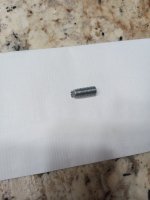
@Auto Doc's, @StarTech Well, I think I may have had some divine intervention. I was surprisingly able to back the broken bolt out with just a screwdriver. I had torqued it so much, that I was sure it had to be pretty stuck in there. I guess the shock of the bolt snapping must have jarred it loose. I picked up 2 new 8.8 bolts to replace them both. I can hand thread the new bolts in almost all the way and they seem snug. I was thinking I would put blue thread lock on the new bolts just in case I did any damage to the threads with the over tightening. Good idea?
Attachments
Auto Doc's
Lawn Addict
I would not use anything on the new bolts except the correct torque. The treads should be fine inside the hole because the broken portion came out so easy.@Auto Doc's, @StarTech Well, I think I may have had some divine intervention. I was surprisingly able to back the broken bolt out with just a screwdriver. I had torqued it so much, that I was sure it had to be pretty stuck in there. I guess the shock of the bolt snapping must have jarred it loose. I picked up 2 new 8.8 bolts to replace them both. I can hand thread the new bolts in almost all the way and they seem snug. I was thinking I would put blue thread lock on the new bolts just in case I did any damage to the threads with the over tightening. Good idea?

Auto Doc's
Lawn Addict
Hi sgkent,
I still prefer the old fashion beam type torque wrenches more than the dial click type.
I still prefer the old fashion beam type torque wrenches more than the dial click type.
andrewslarge
Well-Known Member
Congratulations on getting it out!!!
I’d recommend you order a new original starter bolt. When you install it, I’m certain you’ll get right
I think you got very lucky it came out with a screw driver.
I’d recommend you order a new original starter bolt. When you install it, I’m certain you’ll get right
I think you got very lucky it came out with a screw driver.
Aaaaand....I'll wager that the old starter is just fine only needing disassembly, cleaning the commutator, and inspecting the brushes and reassembly.So I bought the Cub Cadet XT1 with a Kohler 7000 series engine that I had asked about in another thread a couple weeks ago that needed a new starter. The new OEM starter arrived today so I figured I'd do the 15 minute job of installing the new starter before dinner. Things didn't go as planned.... I installed the starter and snugged the bolts to what I thought was adequate but then made the fateful decision to Google the proper torque for the starter bolts, 15-18 ft lbs. So I got out the torque wrench and proceeded to tighten to proper torque. My gut was telling me to stop tightening, as it seemed well beyond adequate, but the steel bolts were still turning fairly easily in the aluminum engine and then SNAP. My 67 year old eyes with cataracts were having trouble reading the numbers on the torque wrench when I set the torque, and it turns out that I set the torque using the top line next to the 10 instead of the bottom line, so instead of setting it to 16 ft lbs it was more like 28. There is no stub of the bolt sticking out of the hole and the bolt sheared at an angle, so now getting the broken bolt out is above my pay grade. (some of you would argue that the simple task of installing the new starter was apparently above my pay grade... ARGG). So is this something that my local lawn mower repair shop should be able to handle easily? Is it possible to get a nut welded onto the sheared bolt inside the hole and just back it out or will it need drilled? I'm guessing I may have damaged the threads in both holes by tightening the bolts so tight and both may now need heli-coils? (I had stopped tightening the left bolt because I was getting worried the bolt would snap and was giving the right side one final snug when it snapped). What should I expect this will cost to have repaired? The picture of the torque wrench is just to show the 2 lines I was referring to, not showing the actual setting.